The General Dental Council’s latest fitness to practise data should catch the attention of every dental professional.
Published in June 2026, the GDC Fitness to Practise Statistical Report 2025 is the most recent annual report of its kind. It provides a detailed picture of the concerns raised about dental professionals, how those concerns progressed, and the outcomes reached across the fitness to practise process.
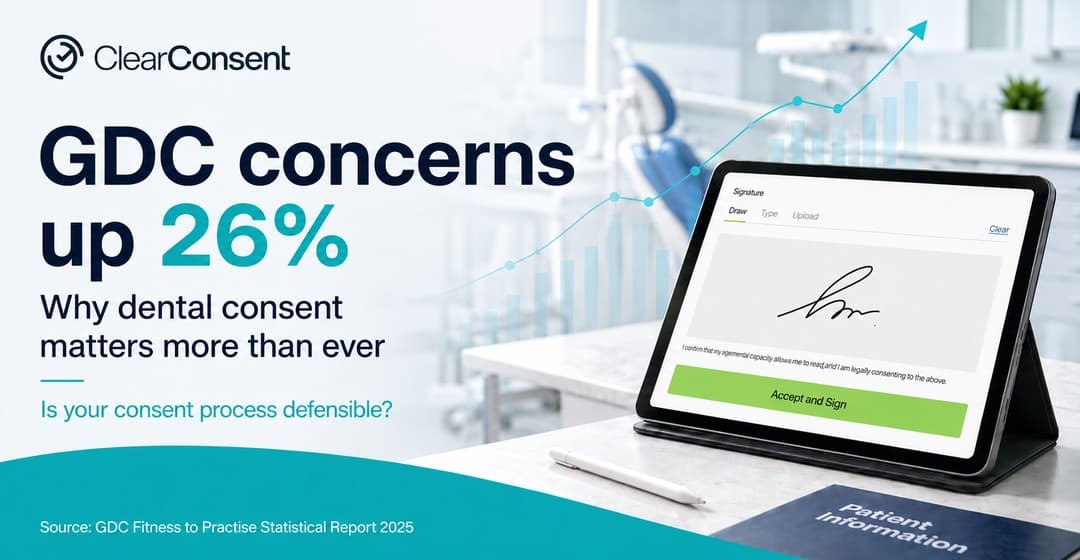
The headline figure is difficult to ignore. The GDC received 1,766 new potential fitness to practise concerns in 2025, compared with 1,401 in 2024. That is a 26% increase in a single year.
The same report confirms that 18 dental professionals were erased from the register in 2025, unchanged from 2024. This represented 0.01% of all registered dental professionals. Of those erased, nine were dentists, six were dental nurses, and the remaining cases involved other dental professional groups.
It would be wrong to suggest that these erasures were caused by consent failures. The GDC report does not say that. However, the report does specifically identify failure to secure a patient’s informed consent before treatment as one of the types of concern the GDC may investigate.
That distinction matters.
This is not about using regulatory data to create fear. It is about recognising a very current and very practical point: consent remains one of the most important areas of professional risk in dentistry, because it sits so closely alongside communication, trust, expectations, records and patient understanding.
In other words, consent is rarely just about the form.
It is about the conversation.
It is about what the patient understood.
It is about what was explained, when it was explained, and how clearly it was recorded.
For modern dental practices, that means consent can no longer be treated as a rushed signature at the end of an appointment.
What the latest GDC data shows
The GDC’s 2025 report shows that fitness to practise activity remains highly relevant to the profession.
According to the report:
- 1,766 new potential fitness to practise concerns were received in 2025.
- This was a 26% increase from 2024.
- 1,743 initial assessment decisions were made.
- 81% of cases reviewed at initial assessment were referred for assessment.
- 17% were closed immediately with no further action.
- 2% were referred to the NHS.
- 110 initial Practice Committee hearings took place in 2025, compared with 73 in 2024.
- 18 dental professionals were erased from the register in 2025.
The GDC also reported that patients remained the largest single source of new concerns. In 2025, patient concerns accounted for 45% of new fitness to practise concerns. Although this was a lower proportion than in 2024, the actual number of patient concerns increased.
For dentists and practice owners, this is significant because many patient complaints begin long before anyone writes to a regulator, indemnity provider or practice manager. They often begin with a gap between what the clinician believes was explained and what the patient remembers, understood or expected.
A patient may feel they were not properly warned about a risk.
They may say they did not understand the alternatives.
They may believe the likely outcome, cost or prognosis was unclear.
They may not remember being told what could happen if they chose no treatment.
When this happens, the strength of the consent process becomes extremely important.
Not simply whether a patient signed a form, but whether the practice can evidence a clear, balanced and patient-centred consent journey.
Consent is specifically within the GDC’s investigatory scope
The GDC explains that it investigates concerns where there may have been a serious departure from professional standards. Within the examples of matters it may investigate, the 2025 report includes:
- failure to examine a patient properly;
- failure to secure a patient’s informed consent before treatment;
- failure to keep satisfactory records;
- failure to respond reasonably to a patient’s needs.
It is worth pausing on that combination.
Consent is listed alongside examination, records and responding to patient needs. That reflects what many experienced clinicians already know: consent is not a standalone administrative task. It is part of the wider standard of care.
The GDC’s Standards for the Dental Team are also clear that dental professionals must obtain valid consent before starting treatment. Patients should be given the information they need to make a decision, including the options available, the risks and benefits, and the likely costs.
A signature may help verify that consent was given, but a signature alone does not make consent valid.
The important question is whether the patient was properly informed and had the opportunity to understand the decision they were making.
That is where traditional dental consent processes can become vulnerable.
Why traditional dental consent forms may no longer be enough
Most dental professionals care deeply about doing consent well. The challenge is that practice life is busy, patients are anxious, diaries are compressed, and complex treatment discussions often need to cover a lot of ground.
A conventional consent process may rely heavily on a chairside explanation, a standard template and a signed document. That can work well when the discussion is thorough, the records are detailed and the patient fully understands what has been explained.
But it can also leave gaps.
A form may record that a patient signed. It may not show that they understood the specific risks of their treatment. It may not show that alternatives were discussed in a meaningful way. It may not show that the patient had time to reflect, ask questions or consider the consequences of no treatment.
This is particularly important for treatments such as dental implants, clear aligners, orthodontics, composite bonding, crowns, bridges, root canal treatment, extractions, sedation and periodontal treatment.
These are areas where expectations matter. Risks matter. Limitations matter. Alternatives matter. Cost, prognosis and long-term maintenance matter.
And if a complaint arises months or years later, the quality of the record matters too.
The real consent question: can you evidence understanding?
A strong consent process does more than deliver information. It helps the patient absorb that information, reflect on it and make a decision that is genuinely informed.
For dental teams, the practical questions are simple but important:
- Was the patient given clear information before treatment?
- Were the risks, benefits and alternatives explained?
- Was the option of no treatment discussed?
- Were costs and limitations made clear?
- Was the information easy for the patient to understand?
- Did the patient have time to consider it?
- Were questions encouraged?
- Was understanding checked?
- Was the process properly documented?
- Could the practice retrieve a clear audit trail if needed?
This is where modern digital consent has an important role to play.
Not because software replaces the clinician. It does not.
The clinician remains responsible for diagnosis, treatment planning, clinical judgement and the consent discussion. But the right consent platform can make that process more consistent, more accessible and easier to evidence.
How Clear Consent supports a more robust consent journey
Clear Consent was built by dentists to help dental practices move beyond consent as a one-off form and towards consent as a clearer patient journey.
The platform allows practices to send patients structured consent information before treatment, giving them the opportunity to review it in their own time, on their own device and at their own pace.
Clear Consent supports:
- digital dental consent forms;
- AI-powered patient consent videos;
- stock or custom AI avatar video options;
- standardised consent workflows;
- practice branding;
- multi-language video support;
- patient comprehension checks;
- digital signatures;
- a clear audit trail for the practice.
The aim is not to make consent more complicated. The aim is to make it clearer.
For patients, that means information that is easier to revisit and understand.
For clinicians, it means a more consistent way to explain treatment, risks, alternatives and expectations.
For practice owners, it means a more reliable consent process across the whole team.
The best consent processes do not feel defensive. They feel professional, respectful and patient-centred. They help patients feel involved in their care, and they help clinicians demonstrate that the right information was shared at the right time.
That is why Clear Consent is more than a signature.
Why this matters for dentists
For individual dentists, consent is both a clinical and professional issue.
Good consent can reduce misunderstandings, improve trust and support better patient relationships. It can also provide a clearer record if a concern, complaint or dispute is raised later.
A stronger consent workflow can help dentists:
- reduce repeated chairside explanations;
- improve consistency across complex treatments;
- support patients with different communication needs;
- document the consent journey more clearly;
- show that key risks and alternatives were covered;
- create a more professional patient experience.
This is especially relevant for clinicians providing higher-risk, higher-value or expectation-sensitive treatment.
Patients do not just need to sign.
They need to understand.
Explore how Clear Consent supports individual clinicians: Clear Consent for Dentists
Why this matters for practice owners
For practice owners, consent is also a governance issue.
A practice may have multiple dentists, therapists, associates, treatment coordinators and administrative team members involved in the patient journey. Without a standardised consent process, the quality and consistency of consent can vary significantly.
That creates risk.
Practice owners should be able to ask:
- Are all clinicians following a clear consent process?
- Are patients receiving appropriate information before treatment?
- Are consent records stored consistently?
- Are complex treatments supported by clear written and video information?
- Are patients being given time to review risks, benefits, costs and alternatives?
- Could the practice respond confidently if a complaint was raised?
Clear Consent helps practices create a more consistent, scalable and patient-friendly approach to consent.
It is not just about reducing risk. It is about raising the standard of care.
Explore how Clear Consent supports teams and clinics: Clear Consent for Practice Owners
A current reminder from the GDC
The latest GDC data should not be read as a reason for panic. Erasure remains rare, and the majority of concerns do not result in the most serious outcomes.
But the 2025 report is still a timely reminder that complaints, concerns and regulatory scrutiny are part of the professional landscape. It also makes clear that informed consent is one of the areas that can fall within the GDC’s investigatory remit.
For dentists and practice owners, the sensible response is not fear. It is preparation.
That means building a consent process that is clear, consistent, patient-centred and properly recorded.
Because the strongest position is not simply being able to show that a patient signed.
It is being able to show that they understood.
Upgrade your consent process with Clear Consent
Clear Consent helps dental professionals deliver consent that is clearer, more consistent and easier to evidence.
With AI-powered videos, digital consent forms, comprehension checks, multi-language support and a secure audit trail, Clear Consent gives practices a modern way to support valid informed consent.
Because consent is not just paperwork.
It is a professional standard.
It is a patient communication process.
And it is a vital part of safer dentistry.
Ready to modernise your consent workflow?
Start here: Get Started with Clear Consent
Or learn more about the platform: Clear Consent — More than a signature
Source note: This article refers to the General Dental Council’s Fitness to Practise Statistical Report 2025, published in June 2026.